How Much To Tip On A Free Walking Tour In Stockholm?
A practical answer to how much to tip on a free, pay-what-you-want walking tour in Stockholm, with cash-versus-app advice, krona guidance, and etiquette for good and disappointing walks.
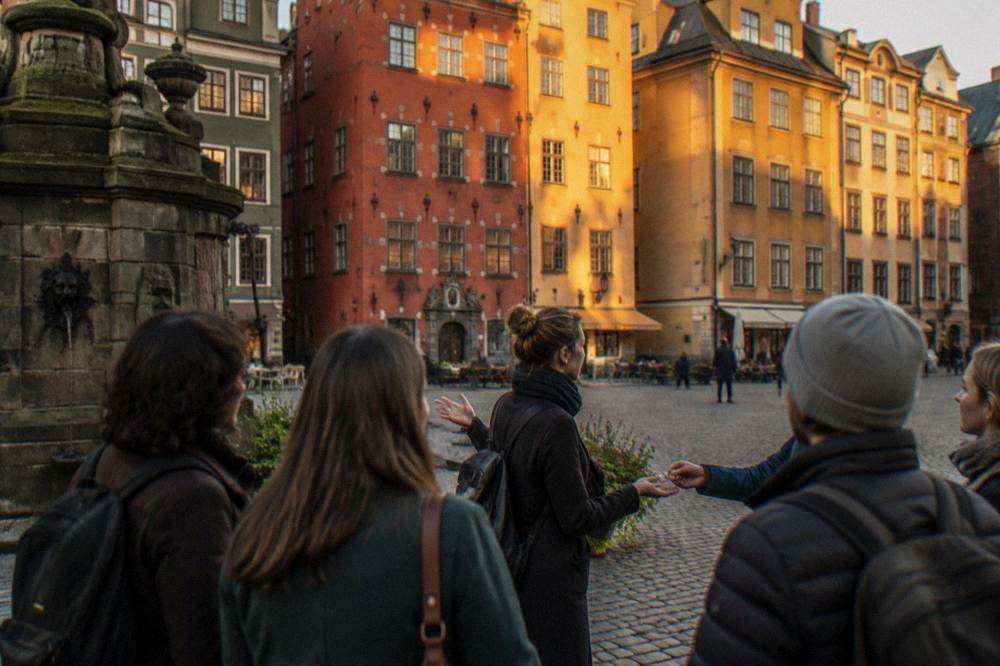
A free walking tour in Stockholm is not free in the sense most first-time visitors assume. The guiding costs nothing up front because it runs on the pay-what-you-want model: you walk, the guide talks, and at the end you decide what the walk was worth and hand that over. That final five minutes is where a lot of travellers freeze, because Sweden is not a tipping culture the way the United States is, yet the person who just spent two and a half hours showing you Gamla Stan does this for a living. This page answers the money question directly, in krona, with the practical details guides wish every visitor knew before the walk ends.
How Much To Tip On A Free Walking Tour In Stockholm?
A common tip on a pay-what-you-want walk in Stockholm lands around 100 to 200 SEK per adult, roughly 10 to 20 US dollars, with 150 SEK a solid middle figure for a two-hour walk that delivered. A shorter or underdelivering walk can reasonably get less, and a guide who was exceptional can be given more. Families usually tip per adult rather than per head, and children are typically not counted at all.
Those figures are planning advice, not a posted tariff, because there is no posted tariff. That is the entire design of the model. No walk on this site's roster charges anything to join, and no guide publishes a recommended tip, so the numbers above are the range that experienced visitors converge on rather than an official price list. If a walk felt worth roughly what a paid guided tour would have cost, tipping toward the upper end of that range is the honest move. If it felt like a pleasant stroll with a few facts, the lower end is defensible and no guide will chase you down Stortorget.
Context matters when you calibrate. A paid guided walking tour in a major European capital typically costs real money per person, and the pay-what-you-want guide covering Stockholm's Old Town is doing comparable work: two to three hours of standing, walking, projecting over street noise, and answering questions in what is often their second or third language. Many of the guides on GuruWalk, the platform where eight of the ten walks featured on this site are listed, run guiding as their actual livelihood rather than a weekend hobby. The tip is not a bonus on top of a wage. It is the wage.
There is also a floor worth naming. Walking away having tipped nothing is legal, possible, and occasionally chosen by people who genuinely could not afford more, and guides accept that as part of the model's risk. But doing it because "Sweden doesn't tip" misreads the situation. Sweden doesn't tip waiters much, true. A pay-what-you-want guide is not a waiter; they are a freelancer whose entire income from the last two and a half hours is decided by the group in front of them.
The first walk worth considering for your krona is the City Centre Views Walk, a 2 hour 30 minute pay-what-you-want walk led by operator Dan Vernier that pairs the Old Town with Stockholm's best central viewpoints. It is a freetour.com exclusive, rated 9.5 out of 10 across 99 freetour.com reviews, and it meets at 11:00 AM with the meeting point given on the freetour.com listing.
Why The Tip Is In Krona, And Why Cash Still Matters In Sweden
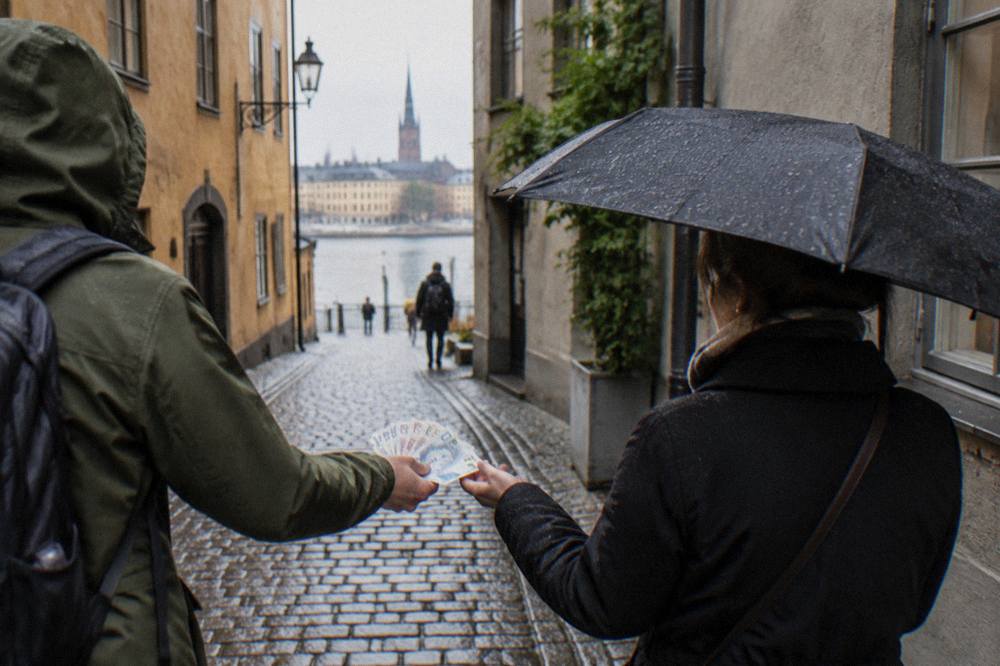
Sweden is close to cashless, but free-tour guides are the exception you should plan for: many collect tips through Swish, the Swedish instant payment app, or a card reader, while some still take cash, so carrying a few hundred krona in notes is the reliable move. Sweden's own currency is the krona, and tipping in euros or dollars is awkward for guides even when they accept them.
The irony of tipping in Stockholm is that one of the world's most cashless societies hosts a tipping economy that still has one foot in paper money. Swish is the local answer: a free app tied to a Swedish bank account that lets a guide display a phone number or QR code and receive tips instantly. If you have a Swedish account, it is frictionless. If you are a visitor with a foreign bank, setting up Swish mid-walk is not realistic, which is exactly why guides who rely on it also carry a card reader or accept cash.
That leaves three realistic options for a visitor, and each has a failure mode worth knowing before the walk ends:
| Payment method | Works for visitors? | The catch |
|---|---|---|
| Swedish cash (krona notes) | Yes, if you withdrew some before the walk | Many Stockholm shops refuse cash, so ATMs are less common than you'd expect; withdraw in advance |
| Card reader (guide's terminal) | Usually, foreign cards generally fine | Occasional small transaction minimums or terminal hiccups mid-crowd |
| Swish QR code | Only with a Swedish bank account | Foreign visitors almost never have one; do not count on this path |
The practical takeaway is simple: stop at an ATM on the way to the meeting point. A few hundred krona in notes removes every payment problem at once, and it lets you hand the tip over directly rather than queuing behind twelve other people for a card reader while the guide is trying to say goodbye to the group.
One more krona-specific note. Tipping in euros is technically possible with some guides, but it creates work for them, and exchange rates get guessed at on the spot. If you are going to tip, tip in the currency the guide actually lives on.
Do You Tip Per Person, Per Family, Or Per Walk?
Tip per adult, not per family unit, and not per walk as a single lump divided by strangers: the standard mental model is that each adult in your party decides their own amount, typically 100 to 200 SEK for a solid two-hour walk, while children and teenagers are usually excluded from the count. Couples most often pool and hand over a combined figure.
The per-adult framing is worth spelling out because group walks create ambiguity. A family of two adults and two children on a two-hour walk is usually looking at a combined figure built from two adult tips, not four full ones. A solo traveller tips one full amount. And in the awkward case where you joined a walk as part of a loose group of acquaintances, each adult settles their own figure rather than one person collecting and redistributing, because nothing sours the end of a good walk like arithmetic negotiations between semi-strangers.
Duration should also bend the number. The walks featured on this site run from 1 hour 45 minutes to 2 hours 30 minutes, and a guide who held a crowd's attention for the longer format through Stockholm's hills and cobblestones has done measurably more work than one covering a shorter loop. Adjust within the range accordingly: the top of the scale makes more sense against a 2 hour 30 minute walk than against a sub-two-hour one.
What If The Walk Was Disappointing? Tipping When It Falls Short
Pay-what-you-want cuts both ways, and a disappointing walk earns a smaller tip without apology: a modest amount is a legitimate, honest signal for a walk that was late, rushed, inaudible, or clearly under-researched, and tipping nothing is reserved for genuinely bad-faith experiences rather than an off day. The model only works if the payment actually tracks the quality.
This is the part of the arrangement that visitors under-use. The pay-what-you-want model is a quality mechanism, not a guilt mechanism. Guides choose it because it lets a good walk earn more than a flat fee, and the same freedom means a weak walk earns less. If the guide started twenty minutes late, skipped a promised stop, spent the walk flirting with one guest, or recited a script with visible boredom, the honest response is a small tip, not a polite full one. Money is the feedback channel the whole system runs on.
That said, calibrate against what actually counts as a bad walk. Weather is not the guide's fault. A shy group that asks no questions is not the guide's fault. A guide switching between English and Spanish for a mixed group, which several walks on this site's roster do, is doing a harder job, not a worse one. And a walk that goes ahead in rain because you showed up in rain has honoured its side of the deal. Reserve the small tip for failures the guide controlled.
There is also a mid-tier worth naming: the fine-but-forgettable walk. Not bad enough to sting, not good enough to remember. Somewhere at the lower end of the usual range communicates exactly that, and guides read the number the way it is intended. Nobody in Stockholm's free-tour scene expects every walk to end in a standing ovation and a top-of-the-scale tip.
Is Tipping On These Walks Different From Tipping In Sweden Generally?
Yes, and the difference is the whole point: Sweden is a low-tipping country where restaurant service charges and wages make gratuity a small rounding gesture, but a free walking tour guide is a freelancer whose entire pay for the walk is the tip, so the usual Swedish restraint does not transfer. Tipping a Stockholm guide at Swedish restaurant levels, a few krona or none, underpays someone who worked on spec.
Restaurants in Stockholm include service, and staff earn proper wages, so rounding up a bill or leaving a small extra amount is a courtesy rather than an obligation. Nobody in the Swedish service sector is working for tips. Free-tour guides are the one case in the country where the visitor genuinely sets the worker's pay, and applying general Swedish tipping instincts to that case produces a category error. The rule of thumb: tip Stockholm guides by the standards of the pay-what-you-want model, not by the standards of a Swedish dinner.
This distinction also answers a question travellers often arrive with, whether the "free" in free walking tour is a marketing trick. It is a pricing model, and an unusually honest one: the guide takes all the risk, the visitor takes none, and the price is set after the service rather than before. If you want the full mechanics of how these walks stay viable, the guide to how free walking tours in Stockholm work breaks down the model from the guide's side, and the piece on whether a free walking tour in Stockholm is really free tackles the same question from the visitor's side.
Which Stockholm Walks Earn Their Tip Most Reliably?
Among the ten pay-what-you-want walks featured on this site, the strongest review profiles are the Viking History Walk at 4.96 across 1,100 GuruWalk reviews, the Swedish History and Society Walk at 4.95 across 355 GuruWalk reviews, and the Three Crowns Free Tour at 4.87 across 93 GuruWalk reviews, figures that belong to the platforms themselves rather than to this site. High ratings do not guarantee your tip's worthiness, but they narrow the odds.
The point of looking at ratings before you walk is not to outsource your judgment, it is to start with a shorter list. Eight of the ten walks featured here are listed on GuruWalk, run by independent local guides, and the other two, both Old Town walks by operator Dan Vernier, are freetour.com exclusives rated out of 10 rather than out of 5. Those two figures are not comparable at a glance, so keep them separate in your head: a 9.6 out of 10 across 225 freetour.com reviews and a 4.8 across 3,000 GuruWalk reviews are both strong, in different currencies of praise.
For a first walk in the city, the Old Town is where the deepest roster sits. The Rainbow Tours Old Town Walk, rated 4.76 across 3,021 GuruWalk reviews, runs 2 hours 30 minutes in English, Spanish and Italian, while the 2-Hour Free Walk, rated 4.69 across 1,433 GuruWalk reviews, is English only and slightly shorter. Whichever you choose, the tip calculus is identical: decide at the end, in krona, based on what the guide actually delivered.
And if history rather than orientation is the reason you are walking, the Viking History Walk is the standout: 4.96 across 1,100 GuruWalk reviews is about as high as the format goes, and it covers Stockholm's Viking and early-history layers that most general Old Town walks only gesture at.
When And How To Actually Hand Over The Tip
Hand the tip over at the walk's end, in person, with a word of thanks: the standard close is the guide announcing the walk is finished, thanking the group, and making the payment moment easy with a card reader, a Swish code, or an open hand, and the visitor's job is simply to be ready rather than to perform. There is no ceremony, no negotiation, and no need to explain your amount.
Readiness is the whole skill. The end of a walk is often chaotic: the group disperses in four directions, the guide is answering one last question, and the people with cash ready go first. Have your notes separated from your wallet before the final stop, or your card already unlocked if a reader is passed around. If you are tipping by card and there is a queue, wait your turn rather than waving your card at the guide mid-goodbye.
A word of thanks costs nothing and lands hard. Guides remember groups that were engaged, and a specific compliment ("the Riddarholmen story was the highlight of our week") alongside the tip is worth more than the same krona handed over silently. You are not obliged to chat, but the tip plus one genuine sentence is the difference between a transaction and a thank-you.
What you should never do is tip at the start. Pre-tipping defeats the model's one quality mechanism, and it can read as a bid to turn a shared walk into a private one. Pay at the end, when the evidence is in.
Common Questions About Tipping On Free Walking Tours In Stockholm
How Much To Tip On A Free Walking Tour In Stockholm?
Around 100 to 200 SEK per adult is the common range for a solid two-hour walk, with 150 SEK a sensible middle figure and a smaller amount acceptable for a shorter or disappointing one. These are planning figures, not a posted price, because no pay-what-you-want walk publishes a tariff.
Is it rude to tip nothing on a free walking tour?
It is possible and not forbidden, but it is rarely the right call. The guide worked the full walk on spec, and their entire pay for those hours is the tip. Tipping nothing is best reserved for a walk that genuinely failed on the guide's side, not for a walk that was merely ordinary.
Can I tip with a card or an app in Stockholm?
Often, yes. Many guides carry a card reader or display a Swish QR code, and foreign cards usually work on the reader. Swish itself requires a Swedish bank account, so visitors should not count on that path and should carry cash as a backup.
Do I tip for children on a free walking tour?
Children are typically not counted at full rate. The usual approach is to tip per adult, with families pooling a combined amount, so two adults with two kids tip roughly two adult amounts rather than four separate full tips.
Does Sweden's low-tipping culture mean I should tip less here?
No. Sweden's general restraint on tipping comes from service-included pricing and proper wages in hospitality. A free-tour guide is a freelancer whose whole income from the walk is the tip, so the pay-what-you-want model's norms apply, not restaurant norms.
Should I tip in euros or US dollars?
It is better not to. Guides live in krona, and foreign notes create exchange-rate guesswork and bank errands for them. Withdraw krona before the walk, or use the guide's card reader.
The short version of everything above: budget 100 to 200 SEK per adult in krona, carry cash as well as a card, decide at the end based on what actually happened, and hand it over with a sentence of thanks. That is the entire etiquette. For more on the walks themselves, start with the best free walking tour in Stockholm or the full roster of free walking tours in Stockholm, collected by Free Things To Do In Stockholm.