Is A Free Walking Tour In Stockholm Really Free?
How the pay-what-you-want model actually works on Stockholm's free walking tours, what the 10 pooled walks on GuruWalk and freetour.com charge, and what a fair tip looks like.
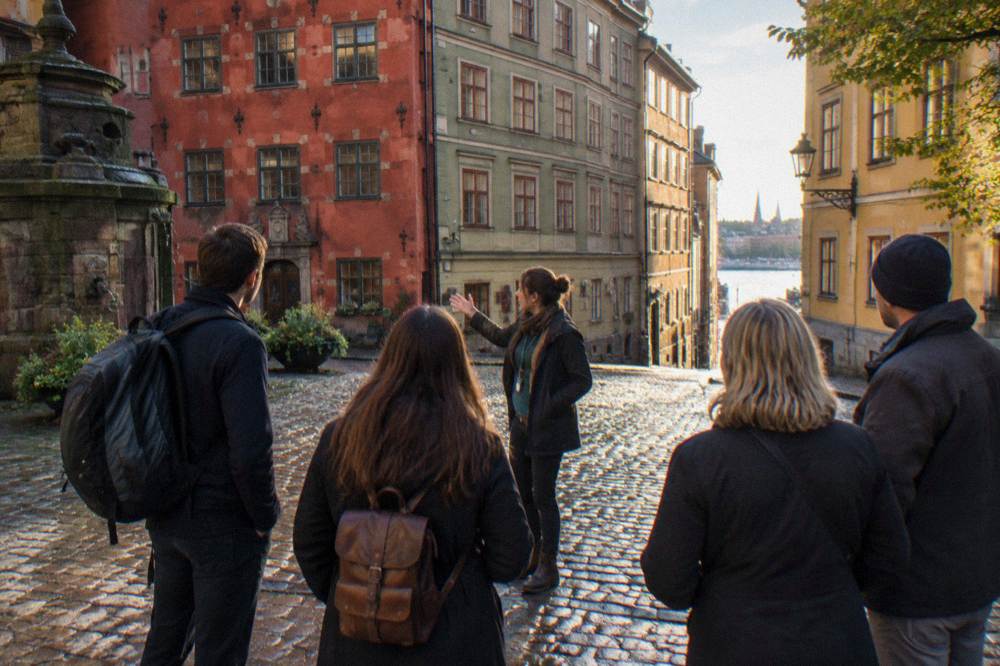
The phrase "free walking tour" earns its quotation marks honestly. Nothing is collected when you join one of Stockholm's pay-what-you-want walks, no card is asked for at the meeting point, and a walker who leaves at the end without paying has broken no rule. The guide is an independent local who runs the walk on GuruWalk or, in two cases, on freetour.com, and their entire income from the tour comes from what participants choose to hand over at the end.
That is the honest answer, but it is only half of it. The model has a social contract attached, a tipping range that most participants treat as normal, and a few practical catches around bookings, no-shows and group sizes. This page lays out how the pay-what-you-want system works across all 10 walks pooled on Free Things To Do In Stockholm, what the guides actually earn, and where the "free" label starts to bend.
Is A Free Walking Tour In Stockholm Really Free?
Yes, in the joining sense: every one of the 10 walks listed on this site costs nothing to book and nothing to attend, because the guides on GuruWalk and freetour.com work entirely on a pay-what-you-want basis. No upfront payment exists anywhere in the model. The cost arrives only at the end, as a voluntary tip in cash or by card, sized by the walker.
That answer covers all 10 pooled walks: 8 listed on GuruWalk and 2 exclusives from the operator Dan Vernier on freetour.com, both of those in the Old Town. The two platforms run the same economics even though the walks sit on different sites. The guide publishes a meeting point, a duration and a language list, walkers show up or book a free spot, and the money conversation happens once, at the farewell.
The distinction that matters is between the price of the ticket and the cost of the experience. The ticket is genuinely free. The experience carries a strong social expectation of payment, and the people who ignore it are, in practice, free-riding on everyone who does not. Calling that "free" is accurate but incomplete, which is exactly why this question gets asked so often.
It also helps to know what this site is. None of these walks are operated here. This is a directory: the listings belong to independent guides, published on GuruWalk and freetour.com, and every figure on this page is attributed to the platform that holds it.
How Does The Pay-What-You-Want Model Work In Stockholm?
The guide sets no price at all. At the end of the walk, the guide says a few words about how they earn their living, and each participant decides what to give, in cash or by card. There is no minimum and no suggested amount printed on the platform's listing page. Both platforms used here, GuruWalk and freetour.com, run every one of the 10 pooled Stockholm walks on this same basis.
Mechically, the tour works like any other walking tour. You find a walk, you reserve a free spot or just show up, you meet the guide at the stated point, and you walk the stated route for the stated duration. The only structural difference is where the money sits: at the end rather than the beginning.
The guide's opening usually covers this in thirty seconds. They will say the tour is free, that they are paid only by tips, and that you should tip what the tour was worth to you. Some guides are more direct than others, and a few will name a range, but nothing is enforced. At the farewell, a hat, a card reader or a payment QR code appears, and the group disperses as it pays.
The reason the model survives is that it self-regulates. Guides who give a weak tour collect weak tips and usually stop running the walk. Walks that run for years with four-figure review counts, like the Viking History Walk at 4.96 across 1,100 GuruWalk reviews or Rainbow Tours' Old Town walk at 4.76 across 3,021 GuruWalk reviews, are walks where thousands of people voluntarily paid after the fact. The ratings are the platform's own, not this site's, and they are the strongest evidence that the tours deliver.
A short comparison of the three walks above, all pay-what-you-want, all in or around Gamla Stan:
| Walk | Platform | Duration | Rating | Language |
|---|---|---|---|---|
| 2-Hour Free Walk, English Only | GuruWalk | 2 hours | 4.69 across 1,433 GuruWalk reviews | English |
| Multilingual Free Walk | GuruWalk | 2 hours | 4.46 across 115 GuruWalk reviews | German, English, Spanish, French, Italian |
| Three Crowns Free Tour | GuruWalk | 2 hours | 4.87 across 93 GuruWalk reviews | English |
The table makes one thing visible: the "free" price is identical across all three, and the only real variables are duration, language and the guide's track record. Choosing between free walks is a choice between guides, not between prices.
A few practical points follow from this structure. Because payment happens at the farewell, it helps to decide before the walk ends how you will pay. If you plan to use a card or a payment app, check that your card works for contactless payments in Sweden, since cash is used sparingly there and some participants prefer the QR code option. If you would rather pay cash, withdraw it in advance, because the guide will not have time to wait while you search for an ATM after the group has dispersed.
Booking behaviour also matters more than on a fixed-price tour. A reserved spot costs you nothing, but a no-show costs the guide a potential tip and takes a place someone else could have filled. If your plans change, cancel through the platform rather than simply not appearing. Groups are often capped, so freeing your spot lets another traveller take it.
Finally, remember that the tip is the guide's entire income from the walk. There is no operator taking a cut behind the scenes and no base wage underneath. If the guide gave you a good two hours, paying nothing is a choice the model permits but does not reward, and the walks with the long review histories survive precisely because most people do not make it.
What Do The Guides Actually Earn?
No published figure exists for what any individual Stockholm guide earns, and this site will not invent one. What can be said is structural: the guide keeps the tips, and the walk only continues if enough walkers pay enough to make it worth the guide's roughly two hours of standing, talking and walking. A walk that has run for years with a four-digit review count is a walk that pays.
The economics explain the model's quirks. A guide leading 20 people who each tip modestly can do well on a summer afternoon; the same walk with four people in a February drizzle can end below minimum wage for the day. This is why booking matters even on a free tour: guides on GuruWalk can see how many people have reserved a spot and may cancel or merge walks when the list is nearly empty.
It also explains why guides sometimes cap group sizes. A pay-what-you-want walk with 40 participants sounds lucrative, but a guide cannot answer questions or hold a crowd's attention at that scale, and the tips per person drop when the experience feels anonymous. The best-performing walks on the roster, such as the Södermalm Viewpoints Walk at 4.81 across 348 GuruWalk reviews, tend to keep groups at a size where the guide can actually guide.
None of this is a reason to feel pressured at the farewell. It is context. The model asks you to price the tour yourself, and pricing it fairly is easier when you understand what the other side of the transaction looks like.
Is Booking Required If The Tour Is Free?
On GuruWalk, reserving a free spot is standard and takes under a minute, and it matters: the guide sees the headcount and decides whether the departure runs. On the two freetour.com walks, booking works the same way, a free reservation with nothing collected. Neither platform charges a deposit, and a no-show on a free booking carries no fee.
The practical advice is simple. Book the free spot, arrive five to ten minutes early, and cancel the booking if plans change, so the slot frees up for someone else and the guide's headcount stays honest. On the Stockholm roster, several walks state arrival windows in their meeting instructions, one asks walkers to be at the big door on Slottsbacken five minutes before departure, and the general etiquette is the same everywhere: the guide is standing outside waiting, and a booked no-show is a person they counted on.
The booking question is also where the "free" label occasionally bends. Some walks on some platforms offer paid private versions alongside the free public walk, and some guides accept paid group bookings for schools and companies. That is a separate product with a real price, listed as such. The public walks themselves remain pay-what-you-want, and the listings linked from this site are those public walks.
What Is A Fair Tip On A Stockholm Free Walking Tour?
There is no official figure, and no platform publishes a recommended amount. The working norm among participants on European pay-what-you-want walks is roughly 100 to 200 SEK per person for a two-hour tour, with 100 SEK read as a fair minimum and 150 to 200 SEK as a solid thank-you for a good guide. Families and students commonly give less, and no guide will comment on any of it.
Those are planning ranges drawn from how participants behave, not operator promises, and this site does not present them as rules. The honest framing is: a free walking tour is a service delivered before it is priced, and the tip is you naming the price afterward. A two-hour guided walk booked through a commercial operator in Stockholm would cost real money up front; the pay-what-you-want walk asks you to decide the same number voluntarily.
The scale should track the tour, not your guilt. A guide who rushed, misread the crowd or got facts wrong has been paid what the tour was worth. A guide who answered every question, adjusted the route for the weather and sent you off with a dinner recommendation has delivered something you would happily have paid for in advance. Most participants land somewhere in the middle of the range above.
For a longer discussion of amounts, currency and payment methods, the companion piece how much to tip on a free walking tour breaks the etiquette down in detail.
Where The Free Label Bends: Honest Caveats
The tour itself is free, but a Stockholm day around it is not, and three costs sit near every walk: getting to the meeting point on the SL network, food and drink the guide may suggest buying during a break, and any museum or attraction the walk passes but does not include. The walk's own price stays zero. Everything adjacent to it is paid at Stockholm's normal prices.
The transport point deserves one clarification because it is asked often. Walking in Stockholm is free, and the meeting points on this roster are all reachable on foot from the city centre, but the SL network that connects them is not free, and the metro art that several walks reference is visible only with a valid SL ticket. The details are covered in getting around Stockholm on foot and by transit.
The museum point matters more on this site than on most. Since the 2022 funding change, Sweden's state museums charge general adult admission, and a guide who walks you past the Royal Palace or stops at a museum facade is not walking you inside it. The Changing of the Guard in the Outer Courtyard is free to watch, the courtyard itself is free public space, but the palace apartments behind it are a paid visit. A free walking tour shows you the free layer of the city, and the paid layer stays paid.
One more caveat, specific to the model: the tour runs only if the guide decides it is worth running. Free does not mean guaranteed. A booked spot with a guide who cancels a thin departure is a real, if uncommon, outcome in the off-season, and the remedy is simply to book another walk from the pool, several of which cover the same ground.
The walk above is the one most first-time visitors should start with, and it is a good worked example of everything this page describes: a free reservation on GuruWalk, a two-hour English-only route from Malartorget 8 outside the Gamla Stan metro, rated 4.69 across 1,433 GuruWalk reviews, and a farewell where the payment happens. Nothing in the listing asks for money before that moment.
Why Do Guides Do This At All?
Because the model works, and because it lowers the risk on both sides at once. The walker risks nothing but two hours, so casual visitors join who would never have pre-paid for a commercial tour, and the guide fills groups that paid tours struggle to reach. The guide's bet is that a well-delivered tour converts most of that larger audience into voluntary payers.
There is a second, quieter reason: the model selects for people who can actually guide. A paid tour sells on photography and search placement before the tour happens; a pay-what-you-want tour is judged entirely afterward, by the same people who just took it. A guide who cannot hold a group does not last many weekends. The review counts on the Stockholm pool, 3,021 reviews on the biggest walk, 1,100 on the Viking walk, are post-hoc verdicts, not marketing.
The walker's side of the bet is equally rational. You get two hours with a local who has chosen to stake their income on your judgment, in a city where the commercial alternative is a fixed price paid to a company before you know what you are getting. For a visitor who wants the city explained rather than just shown, the free walk is the better-designed product, and the tip is its honest price tag.
For a deeper comparison of the two models, are free walking tours worth it weighs the pay-what-you-want walk against the paid commercial tour on the criteria that actually differ.
The walk above shows the model at its most confident. A two-hour Viking history walk, rated 4.96 across 1,100 GuruWalk reviews, meeting at Stortorget in front of the Nobel Prize Museum, in English and Spanish, with no price printed anywhere because none exists. Guides do not put a walk like that on a pay-what-you-want platform unless the tour can carry its own price.
The Short Version
Free means free at the point of entry, on all 10 walks in this site's pool, on both platforms that host them. The payment is voluntary, deferred, and sized by you. The model is not a trick, but it is a transaction, and the honest participant treats the farewell moment as the moment the tour gets priced.
Book the free spot, show up early, tip what the two hours were worth, and cancel if your plans change. That is the whole contract, and it is a better one than most paid tours offer: you see the product before you name its price.
Common Questions About Free Walking Tours In Stockholm
Is A Free Walking Tour In Stockholm Really Free?
Yes, at the point of joining. All 10 walks pooled on this site, 8 on GuruWalk and 2 on freetour.com, cost nothing to book and nothing to attend, and no payment is collected up front. The guide works for tips, and the only money moment is a voluntary contribution at the end.
Do I have to book in advance?
On GuruWalk, reserving a free spot is standard and helps the guide judge the headcount and decide whether the departure runs. The two freetour.com walks work the same way. Booking costs nothing, and cancelling a booking you cannot use is good etiquette.
What happens if I pay nothing?
Nothing, formally. The tip is voluntary and no guide will challenge you. Socially, the model only survives because most participants pay, so a walk you valued and did not pay for is a walk you took at everyone else's expense.
Can I pay by card or only cash?
Most Stockholm guides accept card payments or Swish at the farewell, and cash in SEK is always accepted. Sweden is close to cashless, so a card is the safer assumption, but check with the guide during the walk rather than at the goodbye.
Are the guides licensed or vetted?
The guides are independent locals who publish their walks on GuruWalk or freetour.com, and the platforms carry the review histories. The ratings quoted on this site, such as 4.76 across 3,021 GuruWalk reviews, belong to those platforms and reflect participants' verdicts, not this site's assessment.
Is the tip per person or per group?
Per person is the norm. A couple on a two-hour walk tips roughly twice what one person would, scaled to what the tour was worth. Families with children commonly tip less in total, and no guide comments on the amount.